
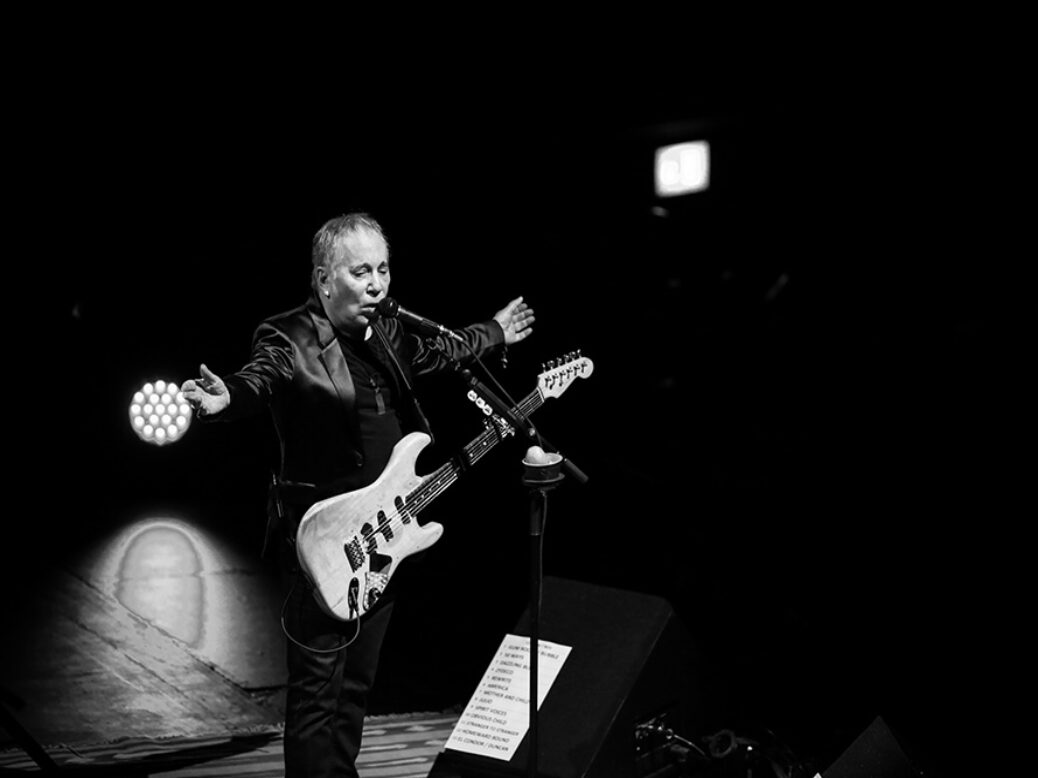
If someone says they’re on a farewell tour, then does another tour a couple of years later, we tend to assume it was all a money-making ruse. But it is worth considering that with some musicians, there may be a genuine attempt to call it a day – before their psyche suffers with the reality of what that means. “I never said I was going to retire. I said I was going to stop,” Paul Simon said, a while back, with a distinction clear, perhaps, only to him. For any serious musician, the onset of old age, and all the things that compromise the ears and the movement of the hands, must be a living death. Happily Simon has been playing around in the between this world and the next for some time. His most recent record, the 33-minute song cycle Seven Psalms (2023) was written in the liminal space between waking and sleeping, its spiritual concept and lyrics delivered in a series of 3am dreams.
Simon once described prayer as “the memory of God” (“The Cool, Cool River”, 1990). In Seven Psalms, God is “a puff of smoke… my personal joke”: he is a forest ranger, an engineer – and Covid. Simon has written about his philosophical struggles with faith, and delivered amusing dialogues with an imaginary maker – but God features most poetically, in his lyrics, as something half-glimpsed and elemental: a “face in the atmosphere”, angels in the architecture, a soul soaring over the Statue of Liberty. His songs are like emblem books – a steady flow of vibrant images, each of which feels like a little clash with the divine. That these moments drop from him shruggingly, casually, in the speech of a New Yorker, only intensifies the sense that God might be here on earth, in music itself. “I lived a life of pleasant sorrows until the real deal came/ Broke me like a twig in a winter gale/Called my name.”
During the recording of Seven Psalms, Simon went deaf in one ear. He entered a deep depression (like grief, this involved a “denial” stage), then picked himself up and spent several months working out how to keep playing and go on tour. A Quiet Celebration, despite its title, is not a stripped-down version of his hits sung in his (admittedly) now very quiet voice. It is not “back to basics”, the likes of which has been done by elderly musicians for years now, often with a blues repertoire and a piece of perspex wrapped round the drum kit.
Rather, it is a wholesale reimagining of his material designed to accommodate his own altered frequencies. Only a musical director – which I am not – could explain exactly what this very clever show is doing, but if you’ve ever seen a Paul Simon show you will know that there are generally very many musicians on stage, and that percussion is a huge part of it. At the Royal Albert Hall, the musicians are still there – around 12 of them – and percussion is still, somehow, the star of the show: there must be 50 drums and shakers of different shapes and sizes, and three men playing them. But there is very little use of cymbal (it plays havoc with the ear) and the snares are brushed rather than whacked with a stick. Most memorably, just as Simon put the accordion in the limelight in the mid-1980s when few others were using it in pop, he has found a new instrument to love, the “cloud chamber bowl” – big spherical perspex vessels of different sizes, hanging from a wooden frame, tickled and teased by mallets to sound like a church bell, or tinkling upwards like a wisp of smoke. The other musicians on stage – guitars, cello, flute – are playing (yes, very quietly) but in a way that is in no sense muted or muddied: they are just applying enormous restraint.

The whole effect is of something powerful and rumbling. It suits Seven Psalms, which takes up the whole of the first set, and is played right through without clapping (Simon basically warns the audience not to clap). He is grey from head to toe – grey jacket, grey hair – but grey in a gentlemanly way, like late-period Leonard Cohen. I have seen many “oldies” at the Royal Albert Hall recently, on tours you suspect may be their last, but I cannot think of any other figures who could make their most recent album, and their most avant-garde, the centrepiece of a tour in this way. I also wonder whether, with this musical restructuring, Simon has pioneered a new approach for rockers in senescence, which will buy them another decade, and enable them to tour right through till death. Long gone are the days when you heard things like, “I’ll do this till I can’t run around on stage any more”. Simon, in warning everyone that this tour is going to be quiet, has set up an expectation of diminished circumstances which he then goes on to obliterate.
He plays two new, hushed versions of tracks from Graceland, which was the first record to abolish the musical generation gap between parents and children (it has never grown back). A fixture for kids in the Eighties listening in their family cars, Graceland’s cartoon imagery – “short little spans of attention”, “roly-poly little bat-faced girls” – was a first taste of bad regimes and dark political forces that lay beyond one’s understanding at the time.
I loved Rhythm of the Saints even more, five years later, where the ethnomusicology aspect was transplanted from South Africa to South America, with a battalion of drummers recorded on the streets of Salvador. The album vibrates with the wet heat of the Amazon, the mulch of a forest floor. Two tracks from it – “Spirit Voices” and “The Cool, Cool River” – were more effective on stage than the Graceland songs, probably because of all the percussion at work behind Simon, which somehow never overwhelmed the words: “I believe in the future, I will live in my car, my radio tuned to the voice of a star.”
Simon’s wife, the singer Edie Brickell, has been joining him for harmonies on this tour and presumably looking after him too. She ran onstage whistling the solo from “Me and Julio Down by the Schoolyard” – before running off again.
And there were a number of Simon’s more impressionistic songs, including 1983’s “Rene and Georgette Magritte with Their Dog After the War” (its title taken from a photo caption) and “The Late Great Johnny Ace” from the same year, inspired by the Fifties blues singer who died on Christmas Day after playing with his revolver backstage. His image is beamed up alongside two other Johnnies who died by gunshot wound, JFK and Lennon, in a meditation on 1964. Simon was living in Swinging London then, and he loved it. It is almost hard to imagine him being excited by The Rolling Stones (which he was), when he ended up veering off into so many diverse forms of music that you can’t actually call him a popstar, or a rockstar.
Perhaps that explains why Seven Psalms felt like the heart of this latest (last?) tour – in all its newness, its strangeness and its… shhh.
[Further reading: Olivia Dean’s definition of love]
Content from our partners


Related
This article appears in the 20 May 2026 issue of the New Statesman, Definitely, maybe
Join the debate
Subscribe here to comment